Why Third‑Party Applications Are the Biggest Patch Management Risk
When most businesses think about patch management, they focus on operating system updates and assume that keeping Windows or macOS current is enough. In reality, third‑party applications are the biggest patch management risk because they are widely used, inconsistently updated, and often excluded from formal patching processes. Common business tools like PDF readers, accounting software, conferencing apps, and industry‑specific programs quietly fall out of date and become easy targets for vulnerabilities. Without a structured approach to managing third‑party application updates, even fully patched operating systems can leave organizations exposed.
Third‑party applications create the largest patch management risk because they are widespread, inconsistently updated, and frequently overlooked in traditional patching processes.
Why Operating System Patching Alone Is Not Enough
Modern business computers run far more than an operating system and a browser. They rely on dozens of third‑party applications that support accounting, collaboration, document management, design, and industry‑specific workflows. Each of these applications introduces its own update cadence, dependencies, and potential vulnerabilities.
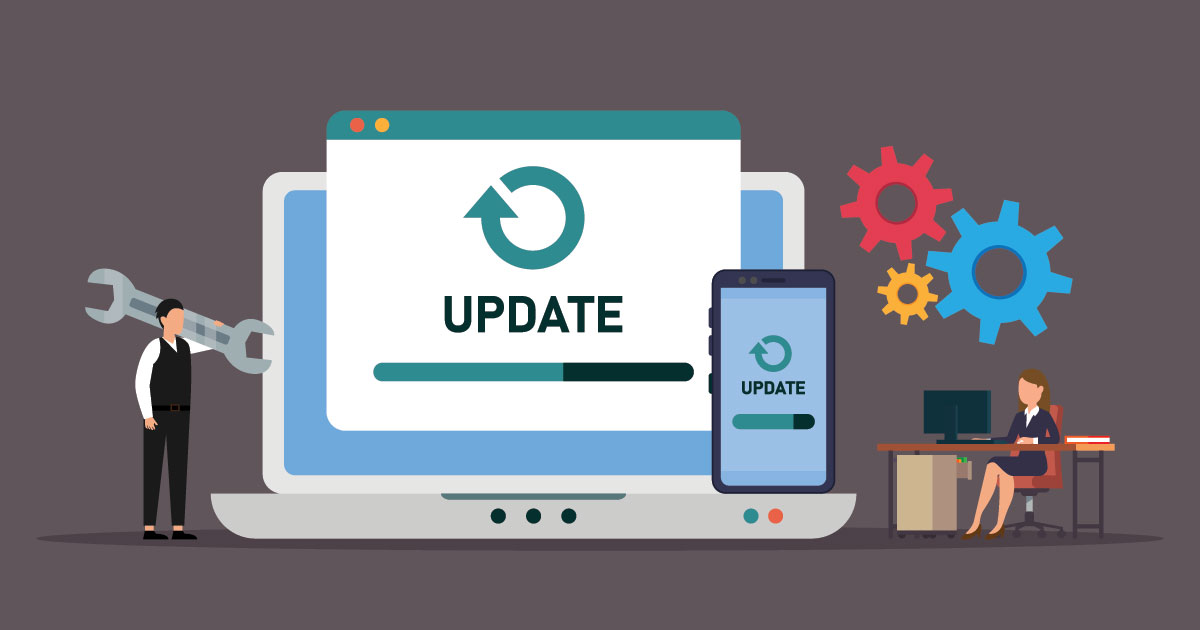
Operating systems are typically patched on a predictable schedule. Third‑party applications often are not. Many rely on user prompts, inconsistent auto‑updaters, or manual intervention, which leads to version drift over time. From both a security and operational standpoint, patching only the operating system leaves a significant portion of the environment unmanaged.
How Third‑Party Business Applications Become the Weakest Security Link
Third‑party applications quietly become the weakest security link because they are everywhere and rarely standardized across devices. Over time, small inconsistencies compound into meaningful risk, especially in growing environments.
Common patterns include:
- Different versions of the same application across users
- Updates that rely on user prompts or manual installs
- Silent update failures that go unnoticed
- Applications installed once and never revisited
As organizations scale, IT teams lose visibility into which applications are current and which are outdated. Leadership assumes patching is happening, but no one can confidently confirm coverage across the environment. This gap is rarely intentional. It is usually the result of treating third‑party updates as secondary to operating system patching.
The Compliance and Cyber Insurance Impact of Unmanaged Applications
Unmanaged third‑party applications introduce more than technical risk. They create compliance and insurance challenges for businesses in regulated industries or those carrying cyber insurance. Auditors and insurers increasingly ask whether patch management extends beyond the operating system.
They want to know if commonly exploited applications are kept current, whether updates are validated, and whether exceptions are documented. When third‑party patching is handled manually or left to users, providing clear answers and proof becomes difficult. This uncertainty can delay audits, complicate insurance renewals, and weaken overall security posture.
Why Third‑Party Application Patching Requires a Different Process
Third‑party applications vary widely in how they install, update, and report success. Some require prerequisites or specific configurations. Others report a successful install even when the application version does not actually change.
Because of this variability, third‑party patching does not scale with simple scripts or one‑off fixes. It requires a process that can reliably detect application state, handle dependencies, apply updates quietly, and confirm the intended result. Most importantly, it requires managing applications against defined standards rather than reacting to individual failures.
Why Louisville Geek Uses Immy Bot for Third‑Party Application Updates
Addressing this risk requires more than good intentions. At Louisville Geek, we treat third‑party application patching as a core part of our managed patch management service, not an afterthought. We chose Immy Bot because it supports a standardized, declarative approach to managing third‑party applications at scale.
Instead of running updates and hoping they succeed, Immy Bot allows us to define what applications and versions should exist on a system and continuously evaluate devices against that standard. It maintains a curated library of commonly used business applications, including complex software that is traditionally difficult to update consistently.
Immy Bot also validates outcomes. If an update reports success but the application version does not actually change, the issue is flagged rather than assumed resolved. This validation is critical for maintaining confidence that third‑party applications are truly up to date.
At this point, the challenge is no longer awareness. It is execution at scale.
Managing Third‑Party Applications Using a Desired State Approach
Third‑party application patching works best when it is tied to a desired state. Instead of asking whether an update ran, the question becomes whether the system matches the defined standard. Approved applications should be present, supported versions should be installed, and outdated software should be corrected automatically.
Managing toward a desired state keeps environments consistent over time, even as devices are added, replaced, or reassigned. This approach reduces security risk, limits configuration drift, and minimizes operational noise. It also bridges the gap between routine maintenance and ongoing protection.
What Business Owners Should Expect From Third‑Party Patch Management
From a business perspective, effective third‑party application patching should feel quiet and predictable. Applications stay current without constant prompts, and systems behave consistently across teams and locations.
Business owners should reasonably expect that:
- Approved applications stay current without user intervention
- Systems behave consistently across teams and locations
- Patch coverage can be clearly explained and validated
- Exceptions are intentional, documented, and reviewed
Security reviews and insurance conversations become easier because patch coverage is clearly defined and validated. IT teams spend less time chasing updates and more time supporting strategic initiatives. Most importantly, leadership gains confidence that patch management covers the full environment, not just the operating system.
Why Third‑Party Applications Define Patch Management Success or Failure
Operating system patching is necessary, but it is not sufficient. In most environments, third‑party applications represent the largest and least visible patch management risk. Ignoring them undermines security, compliance, and stability, even when operating systems are fully up to date.
Patch management is only as strong as its weakest application. Addressing this risk requires standardizing applications, automating updates, validating results, and monitoring for drift over time. This is how patch management moves from assumption to assurance.
How to Reduce Third‑Party Patch Risk With a Managed Patch Management Service
Reducing third‑party patch risk requires more than tools. It requires a managed process built around software standards, validation, and continuous alignment. When third‑party application patching is delivered as part of a formal managed service, risk is reduced and confidence increases.
This approach is especially important for organizations with cyber insurance requirements, compliance obligations, or growing application complexity. Louisville Geek delivers patch management as a managed service that includes both operating systems and third‑party applications, supported by defined standards and ongoing validation. If you want to understand how third‑party application patching fits into a mature patch management program, contact Louisville Geek to start the conversation.
About Louisville Geek
Louisville Geek is a managed IT services provider based in Louisville, Kentucky, serving organizations across Kentucky and the United States. We deliver secure, compliant, and scalable IT services designed to support long‑term business goals.
Our team specializes in managed IT services, cybersecurity, cloud solutions, disaster recovery, and operational process maturity. We work with healthcare, financial services, manufacturing, professional services, and other regulated industries that require reliable IT and clear accountability.
At Louisville Geek, we focus on predictable outcomes, not reactive fixes, helping businesses operate with confidence as technology evolves.